
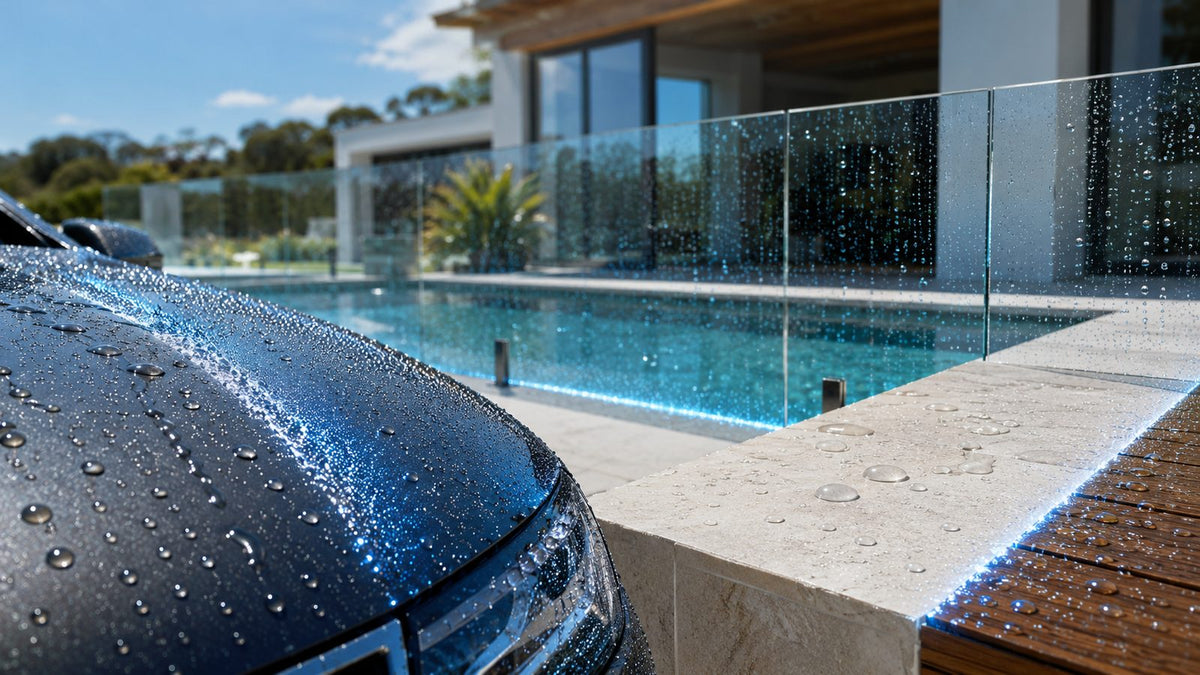
Hydrophobic nanotechnology uses ultra-thin layers at a microscopic level to repel water, slow grime build up and make cleaning easier. Instead of sitting on top like a traditional film, nano coatings bond with the surface to create durable, invisible protection across materials.
Water is simple. The way it behaves on a surface is not. On untreated glass, stone, paintwork or timber, water can spread, cling and leave contaminants behind as it dries. Hydrophobic nanotechnology changes that interaction at the surface. Instead of wetting a wide area, water is encouraged to form tighter beads that move away more readily.
That small change can make a practical difference: less water remains in contact with the surface, dirt and grime have a harder time settling into a stubborn film, and routine cleaning can become faster and easier. It is the science behind Future Shield’s approach to complete surface protection.
What does “hydrophobic” actually mean?
Hydrophobic means “water-repelling”. Scientists assess this using the contact angle: the angle formed where a water droplet meets a surface.
On a surface that water readily wets, the droplet flattens and spreads. As water repellency increases, the droplet becomes rounder and sits higher on the surface. In surface science, a contact angle above 90 degrees is generally described as hydrophobic; above 150 degrees is commonly described as superhydrophobic.
The important point for everyday use is not the terminology. It is the behaviour: water beads rather than forming a broad sheet, and moving droplets can carry loose particles away. Researchers often compare this with the lotus leaf, whose microscopic surface structure helps water roll away while collecting dust.
Where nanotechnology enters the picture
A nano coating is engineered at an extremely small scale. When correctly prepared and applied, the coating forms or bonds as a very thin protective layer across the substrate. Its surface chemistry and structure reduce how easily water wets the material underneath.
The coating is not a bulky plastic cover and it is not a force field. It works at the interface between the surface and the outside environment. That is why a coating can remain visually discreet while changing how water and everyday contaminants behave.
Four practical benefits of hydrophobic protection
1. Water beads and moves away more readily
Less wetting means less water is left spread across the treated area. On glass and glossy surfaces, that can make rinsing and drying more manageable.
2. Dirt and grime are easier to release
A hydrophobic layer can make it harder for water-borne grime and everyday contaminants to grip the underlying surface. The surface still needs cleaning, but stubborn build-up may require less effort to remove.
3. Surfaces can stay cleaner for longer
Because water and loose contamination are less likely to sit as a film, protected surfaces may keep their clean appearance for longer between routine washes.
4. Maintenance can become more efficient
Easier-release surfaces can reduce repeated scrubbing and support simpler aftercare. The result is more time enjoying the vehicle, home or outdoor area and less time fighting the same build-up.
One technology, many everyday surfaces
Vehicles and bikes
Hydrophobic protection can support easier cleaning of paintwork, rims, glass, metal, plastics and other compatible exterior finishes. Explore Future Shield’s Automotive protection range, or read more about how hydrophobic protection can transform car care.
Glass, showers and pool areas
Water marks, soap residue and outdoor contamination can quickly dull clear surfaces. Hydrophobic treatment helps water release more readily and can simplify regular upkeep. Explore Future Shield’s Domestic range and our guide to protecting pool glass.
Stone, concrete and timber
Porous materials need a coating designed for their specific structure. Research into nano-enhanced protectants shows how water resistance can be improved while surface appearance and breathability remain important design considerations.
Future Shield provides dedicated protection options across its Domestic and Industrial collections.
Marine environments
Boats and marine surfaces face repeated water exposure and ongoing cleaning demands. A compatible hydrophobic treatment can support easier maintenance across suitable glass and exterior surfaces. Browse the Future Shield Marine collection.
What a nano coating does — and what it does not do
Good surface protection starts with realistic expectations. Hydrophobic coatings help repel water and reduce the adhesion of everyday contamination.
They do not make every material completely waterproof, eliminate cleaning forever or prevent all scratches, chips, impact damage and neglect.
Performance also depends on choosing the correct product, preparing the surface thoroughly, applying it as directed and following the recommended aftercare. A premium coating applied to a contaminated or incompatible surface cannot deliver its best result.
Why preparation matters as much as the coating
- Choose a product made for the specific material you want to protect.
- Remove existing dirt, oils, residue and contamination before application.
- Make sure the surface is properly dry and follow the product directions.
- Allow the coating to cure for the stated period before exposing it to water or cleaning.
- Use suitable maintenance products and avoid harsh or abrasive cleaning methods.
Built for the surfaces Australians use every day
Australian surfaces can face strong sunlight, sudden rain, coastal exposure, dust, mineral-rich water and constant outdoor use. Future Shield’s range is designed around real applications — from cars, motorcycles and marine surfaces to glass, stone, concrete, timber and textiles.
The goal is simple: protect more and clean less. By changing how water and grime interact with the surface, hydrophobic nanotechnology gives owners a smarter first line of defence and a more manageable maintenance routine.
Ready to find the right protection?
Explore all Future Shield products or contact the Future Shield team for help choosing a coating for your vehicle, home, marine or commercial surface.
Sources and further reading
Royal Society of Chemistry — A review on self-cleaning coatings
Scientific Reports — Research into hydrophobic coatings and self-cleaning performance
Heritage Science — Research into nano-material enhanced protectants for natural stone
Future Shield — Product collections and application information



Leave a comment
This site is protected by hCaptcha and the hCaptcha Privacy Policy and Terms of Service apply.